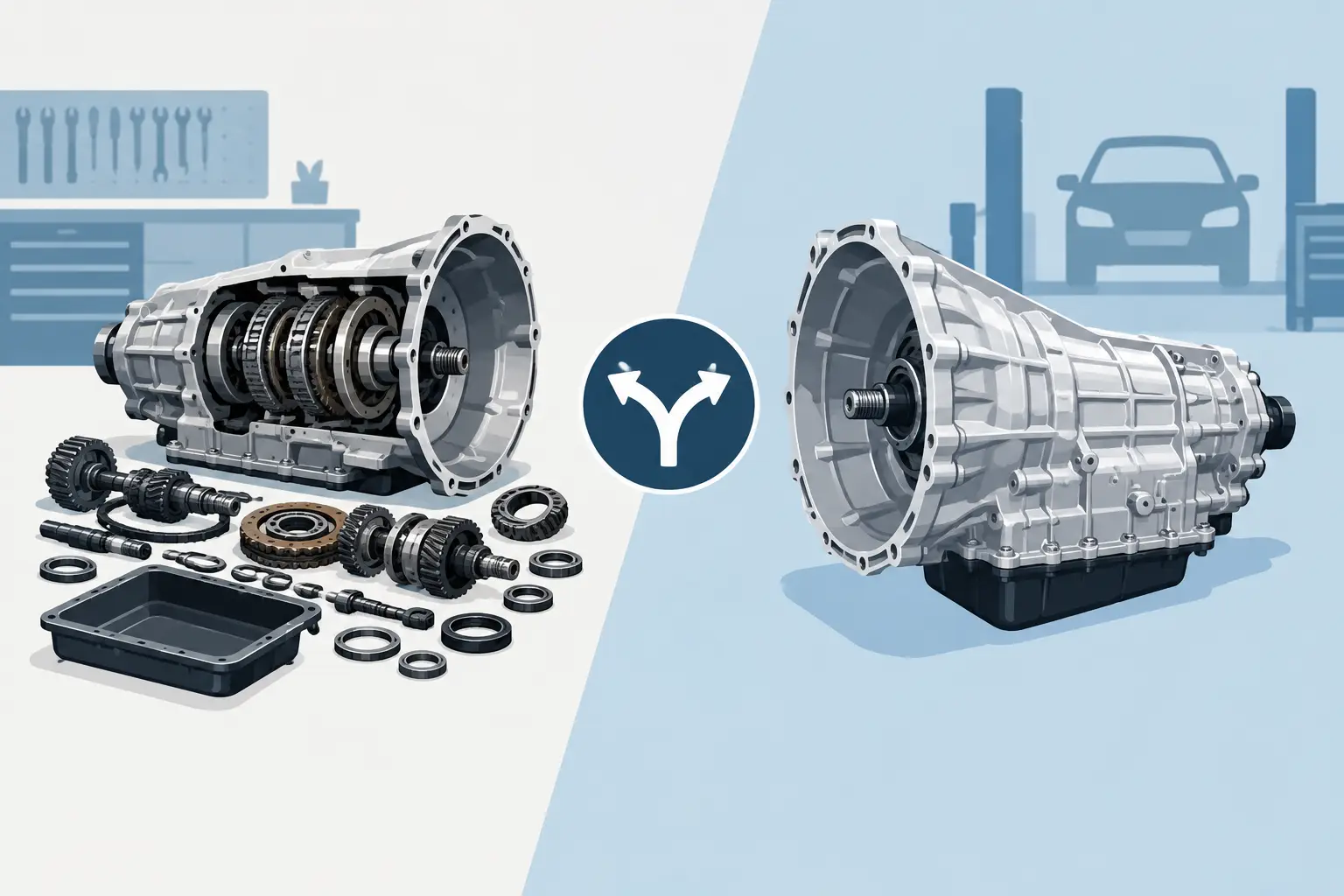
A slipping transmission at a busy intersection, a delayed shift pulling onto I-75, or a warning light that will not go away can make one question feel urgent: transmission rebuild versus replacement – which is the right call? The honest answer is that it depends on what failed, the condition of the rest of the unit, your vehicle, and how long you plan to keep it. A good repair decision starts with diagnosis, not a guess or a one-size-fits-all recommendation.
Transmission Rebuild Versus Replacement Starts With Diagnosis
Transmission trouble can feel similar from the driver’s seat even when the repair is very different. Low or burned fluid, a faulty sensor, a valve body problem, internal clutch wear, torque converter failure, wiring damage, or a problem outside the transmission can all cause harsh shifting, slipping, shuddering, or a no-move condition.
That is why the first step should be a careful inspection. An experienced technician looks at fault codes, fluid condition, leaks, road-test behavior, electrical inputs, and mechanical operation. On some vehicles, further testing is needed to confirm whether the problem is limited to an external component or whether the transmission must come out for internal inspection.
A transmission should not be rebuilt simply because a warning light came on. On the other hand, replacing a sensor will not solve internal damage. Clear diagnostics protect you from paying for work your vehicle does not need.
What a Transmission Rebuild Means
A rebuild is an internal repair of your existing transmission. The unit is removed, disassembled, cleaned, and inspected component by component. Worn friction clutches, seals, gaskets, bushings, and other failed parts are replaced. Hard parts such as gears, drums, shafts, and the case are checked closely and replaced if they are damaged or outside specifications.
The value of a rebuild is precision. Instead of installing a complete assembly with an unknown history, the technician can identify the actual cause of failure and address it. If a particular clutch pack burned up because of a valve body issue, fluid contamination, or a worn internal part, those related concerns need attention too. Otherwise, a replacement unit can be put at risk of the same failure.
A properly rebuilt transmission is not just an old transmission put back together with new fluid. Quality depends on the inspection process, the parts selected, the condition of reusable hard parts, and the technician’s knowledge of known issues for that make and model. Modern transmissions are complex hydraulic and electronic systems. Details matter.
Rebuilding can be a strong choice when the vehicle is otherwise in good condition, the transmission is rebuildable, and you plan to keep the vehicle. It also makes sense when an in-house shop can explain exactly what it found and what parts are being replaced.
There are limits. Severe case damage, widespread hard-part failure, or a unit with poor parts availability can make rebuilding less practical. A rebuild also takes time because the transmission must be removed, inspected, cleaned, repaired, reassembled, reinstalled, and tested. That time is worthwhile when it produces the best repair, but it should be discussed upfront.
What Transmission Replacement Can Mean
“Replacement” sounds simple, but it can mean several very different things. A replacement transmission may be a used unit from a salvage vehicle, a remanufactured unit rebuilt by a supplier, or, less commonly, a new unit from the vehicle manufacturer.
A used transmission can have a lower initial price and may be appropriate for certain older vehicles or situations with a limited budget. The trade-off is history. Mileage records do not always tell the whole story, and the internal condition cannot be fully known without taking the unit apart. The same model transmission from another vehicle may also need programming, updates, or supporting repairs before it will operate correctly in yours.
A remanufactured transmission is generally rebuilt by a production supplier rather than by the shop installing it. These units can be a practical option when availability is good and the vehicle calls for one. Still, the installer should check the related systems that may have contributed to the original failure. Cooling lines may need flushing, the transmission cooler may need replacement, and electronic or valve body issues must be resolved. Installing a good unit into a contaminated system is a costly mistake.
A new factory transmission may offer the most direct factory-parts route, but it can be expensive and may not be available for older vehicles. It is not automatically the best value simply because it is new. The right choice depends on total repair cost, vehicle condition, availability, and your goals.
Cost Is More Than the Price of the Unit
When comparing estimates, ask what is included. A quote for a rebuild or replacement may involve removal and installation labor, fluid, filters, seals, programming, cooler service, torque converter work, mounts, and repairs to related components. A low number that leaves out necessary work is not a lower final cost.
The vehicle itself matters, too. A well-maintained truck, SUV, or family vehicle with years of useful life left may justify a more complete repair. If the vehicle has extensive engine, rust, suspension, or electrical problems, a less expensive path may be more sensible. Honest advice should consider the whole vehicle, not just the transmission on the workbench.
For fleet owners, downtime has a cost as well. The least expensive option is not always the option that gets a working vehicle back into dependable service. The same is true for retirees, working families, and small-business owners who rely on one vehicle every day.
Questions That Help You Make a Clear Decision
Before approving either repair, you should be able to get plain answers. What specifically failed? Is the damage internal or external? What condition are the major internal parts in? Why is a rebuild, used unit, remanufactured unit, or factory unit being recommended for this vehicle?
It also helps to ask what related repairs are needed to protect the transmission after installation. A shop should explain whether it found contaminated fluid, cooling restrictions, converter damage, software concerns, or electrical faults. These details are not scare tactics when they are supported by the inspection. They are often the difference between repairing the cause and only replacing the symptom.
Ask how pricing is handled if additional damage is discovered after teardown. Internal transmission damage cannot always be fully confirmed before the unit is removed and opened. The fair approach is communication: explain what was found, show or document the failed components when possible, provide options, and get approval before moving forward.
If you have an extended warranty, confirm what it covers and what diagnostic steps are required for authorization. Warranty work still deserves the same careful diagnosis and explanation. Shift Right Transmissions works with extended-warranty claims without charging an administrative fee, helping customers understand the repair process without adding unnecessary confusion.
When a Rebuild Is Often the Better Fit
A rebuild is commonly worth considering when inspection shows the unit has a repairable internal failure and its major hard parts are in usable condition. It can be especially appealing for vehicles you know well and intend to keep, because the repair can be tailored to what that exact transmission needs.
It may also be the better answer when the failure has a known cause that can be corrected during the rebuild. Replacing the worn parts without addressing the cause would be incomplete. A careful rebuild gives the technician an opportunity to inspect the entire unit rather than relying on the unknown condition of another transmission.
When Replacement May Be the Better Fit
Replacement may make more sense when the existing case or hard parts have extensive damage, parts are unavailable, or a quality remanufactured unit offers a better value for the vehicle. It can also be a reasonable choice when time, budget, and parts availability point clearly in that direction.
The key is not to treat every replacement unit as interchangeable. Proper installation includes checking the cooler circuit, electrical connections, software requirements, fluid specifications, and any other condition that could damage the replacement. The transmission is only one part of the system that makes your vehicle move.
A major transmission repair is never a fun phone call, but it should not leave you in the dark. Choose the option that is supported by real findings, explained in plain language, and priced with the necessary work out in the open. That gives you the best chance of spending wisely and driving away with confidence.
Leave a Reply